Ask Better, Talk Less
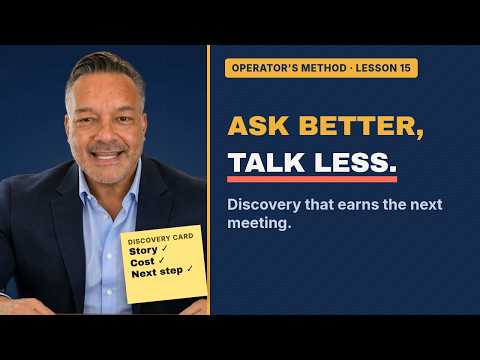
Ask better, talk less: their story comes before yours, and good discovery earns the next meeting.
Plays from YouTube (privacy-enhanced mode). Prefer YouTube? Watch it there.
Before your next first meeting, write your five questions, and don't quote until you've asked them.
In this lesson
Their story before yours: if you don't hear their story first, you don't know which of yours to tell. Never ask "any problems?" Ask about an event: "When was the last time a claim surprised you?" Generic questions tell the buyer you're not an expert.
The four kinds of questions
- Where they are: "When's your comp renewal, the exact effective date, and who's quoting it for you this year?" Then the real why-now: "Are you planning to just renew, or are you actually looking, and what's got you looking?"
- What's not working: "Do you know what your experience mod is right now, and has anyone ever shown you whether it's even accurate?" · "When's the last time your agent walked your loss runs with you and pushed to close the open claims?" · "How'd your last premium audit go?"
- What it costs: "Any claims sitting open you'd swear should've closed years ago?" Open claims push the mod up. Even a dull question ("How often do you run payroll?") can find money.
- What fixing it is worth: "Is your mod ever costing you more than premium, like keeping you off a bid or a vendor list?" · "If we got that number down and kept it down, what would that open up for you?"
Only get three? The window, the mod and the bid. Don't quote until you've asked all five. The buyer does the math, not you.
Listen like you mean it: facts, feelings, and what it means for the business. Ask, then hold the silence and let the buyer break it. Then say it back: "What I'm hearing is… Am I on the right track?"
The question that changed the deal (Ronnie's story, real, details changed): a printer project at a big manufacturer looked like free money until one question, "Why isn't this exciting to you? Why isn't it landing?", showed the copier line was their think tank. Don't diagnose their pain without asking what it is. Discovery doesn't always happen in a meeting, either: Ronnie found the egg-house deal (Lesson 7) as a regular customer, by noticing and asking.
Earn the next step: find out who has a say, when it has to be done and who signs. In comp, get the loss runs and the mod worksheet in or before the first real meeting. Book the second meeting with two specific times, and send a same-day recap.
Qualify, and let them go clean: "I don't want to waste your time. If this isn't for you, or now's not the time, just tell me. I won't be hurt." Ronnie's qualified pipeline ran a 30–40% hit ratio, versus 5–10% for a padded one. Brush-offs get their own short: One More Hit.
Caution: never make up the pain. No fake numbers, no horror stories. If you don't know what it costs, ask them to estimate.
Field assignment and Friday review
fill in the Discovery Card before each call. Don't quote until you've asked all five. After each call, check: did they tell you a story? Did you say it back and hear "that's right"? Is the next meeting on both calendars? Friday: show your manager the card.
Optional: we're putting together one bundle of workbooks and trackers, one low price, no upsell. It's coming to ronnieodell.com. Every lesson and worksheet stays free.
Sources and credits
- The four kinds of questions: adapted from published sales books and the formal sales training Ronnie certified in early in his career.
- Their story before yours, saying it back, the silence, and a specific next step: adapted from published sales books.
- Ronnie's own experience: thirty years in sales, with insurance part of it the whole time. The stories are his; names, companies and carriers left out, details changed.
Disclosures
- The meeting is a dramatized producer discussion. The producers, the roofing contractor and the drill are made up. The stories Ronnie tells as his are real, with details changed.
- AI avatars and an AI voice of Ronnie O'Dell. The lessons and opinions are Ronnie's.
- Educational content only. Not legal, tax or insurance advice. Experience-mod and submission-timing rules vary by state, bureau and carrier.